Solar Panel Cost in Nottingham (2026): Prices, Payback and the Best Panels to Buy
Energy bills have been a fun ride these last few years, haven’t they? The kind of fun where you open the app and immediately wish you hadn’t. So it’s no surprise that more Nottingham homeowners are looking past the next quarterly bill and asking a bigger question: what would solar actually cost, and would it pay for itself? Here’s the honest answer for 2026.
And before anyone says it’s too grey up here, Nottingham is sunnier than you’d think. Government data shows 36,232 homes in the city have already gone solar, that’s 10.1% of households, nearly double the national average of 5.7%. The grey-skies excuse doesn’t really hold.
How much solar panels cost in Nottingham in 2026
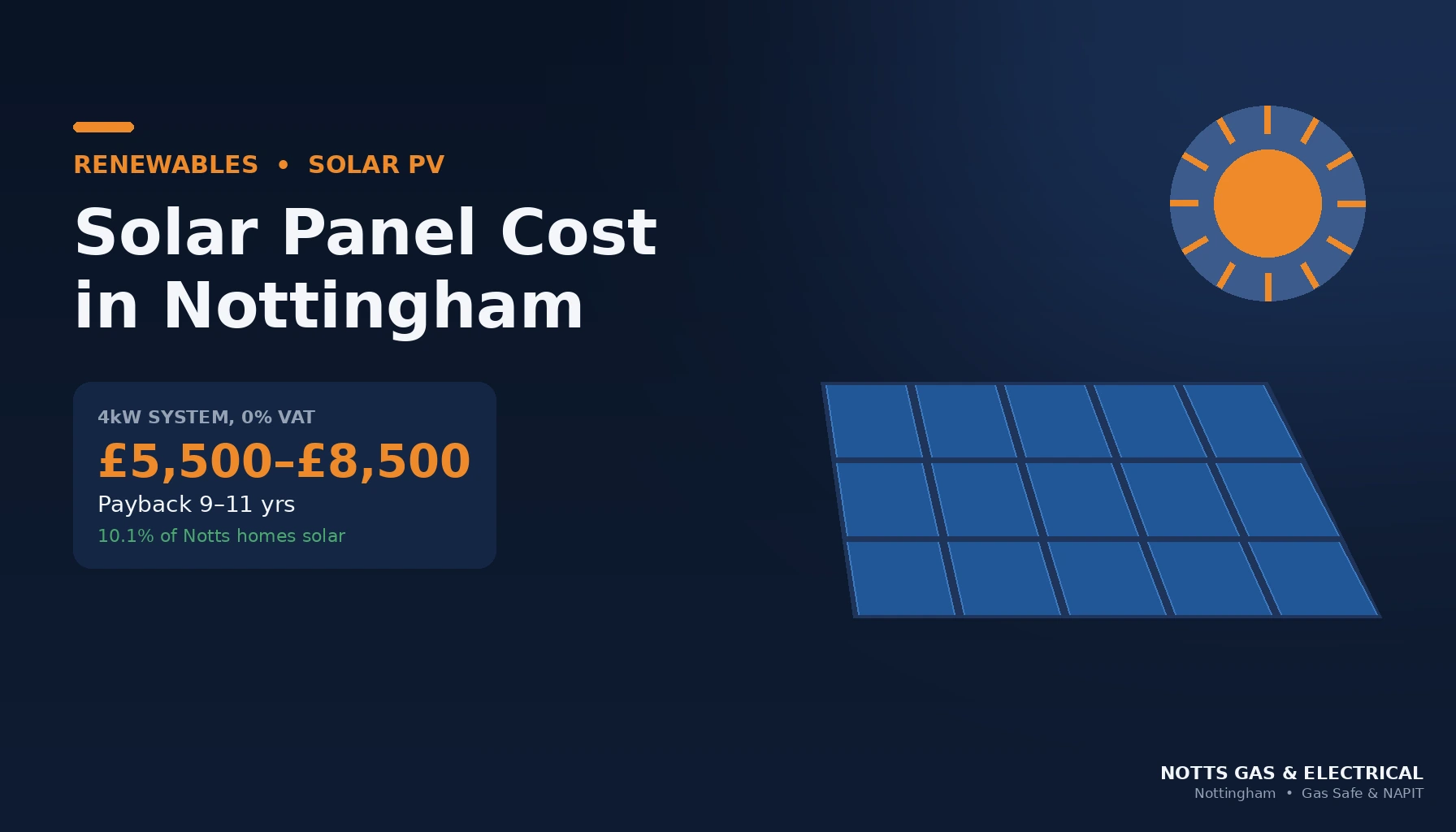
A standard 4kW system, which suits a typical three-bed home, costs roughly £5,500 to £8,500 fully installed in 2026, with the average around £7,500. Add a battery, and you’re looking at £10,000 to £14,000 for the combined setup.
Crucially, residential solar carries 0% VAT until 31 March 2027, after which it’s currently set to revert to 5%. That’s a real saving of £1,000 to £3,000 baked into the prices above, and a genuine reason not to dawdle if you’re already minded to do it. Panel prices themselves have fallen about 90% since 2010, so solar is close to the cheapest it’s ever been.
The best solar panels to buy in 2026
Panels are split into tiers, and the right choice depends on how long you’re staying put and how much roof you’ve got.
At the premium end, brands like Aiko and Maxeon offer the highest efficiency, squeezing more generation out of a small or awkward roof. They cost more, and the payback on that premium alone can be long, so they make most sense when roof space is tight.
In the middle, Trina Solar, JA Solar and Canadian Solar are the workhorses. These are Tier 1 panels with strong track records and sensible pricing, and for most three-bed semis, they’re the best risk-adjusted choice.
Budget panels exist and aren’t necessarily bad, but watch the warranties. Premium panels carry 25-year product warranties; budget ones sometimes only 10-12. On a system you expect to run 25 years or more, a mid-life failure during your payback period stings. For most people, mid-range Tier 1 is the sweet spot.
Payback and the SEG, the honest maths for a Midlands roof
A 4kW system on a south-facing Midlands roof typically pays back in 9 to 11 years, then gives you 15-plus years of near-free electricity after that. Your savings come from two places: the electricity you don’t buy, and the surplus you export.
That export is paid through the Smart Export Guarantee (SEG). Rates vary wildly by supplier. Octopus Outgoing is around 12p per kWh, while some others pay 4-6p, so the tariff you choose genuinely changes your return by hundreds a year. It’s free to switch, so it’s worth getting right.
A quick reality check on payback claims: be sceptical of any quote that assumes aggressive energy-price inflation to make the numbers look good. Honest sizing and current rates give you a conservative figure you can actually trust.
Do you need a battery too?
Not necessarily on day one. A battery lifts the share of your own solar you actually use from around 50% to 80%, which is great if you’re out during the day, but it adds £2,500 to £6,000 and extends the payback. For a lot of homes, maximising panels first and adding battery storage later (or alongside, to keep the 0% VAT) is the smarter order. If you’ve got an EV charger, the maths shifts in the battery’s favour because you’ve got somewhere useful to put the surplus.
Why honest sizing beats panel count
We won’t oversell you a 12kW array if your roof and your usage say 6kW is the smarter spend. Ten panels could be 3.8kW or 4.5kW depending on wattage, so compare total output and estimated annual generation, not just how many rectangles end up on your roof. Every system should be sized to your actual property and consumption, with clear payback maths and no hard sell.
Because we already handle the gas and electrics in plenty of Nottingham homes, the solar PV installation ties into your existing setup as one straightforward job rather than a separate puzzle bolted on by strangers. If you’d like a genuine, no-pressure look at what solar would do for your home and your bills, give Notts Gas & Electrical a ring on 0115 990 3308.