
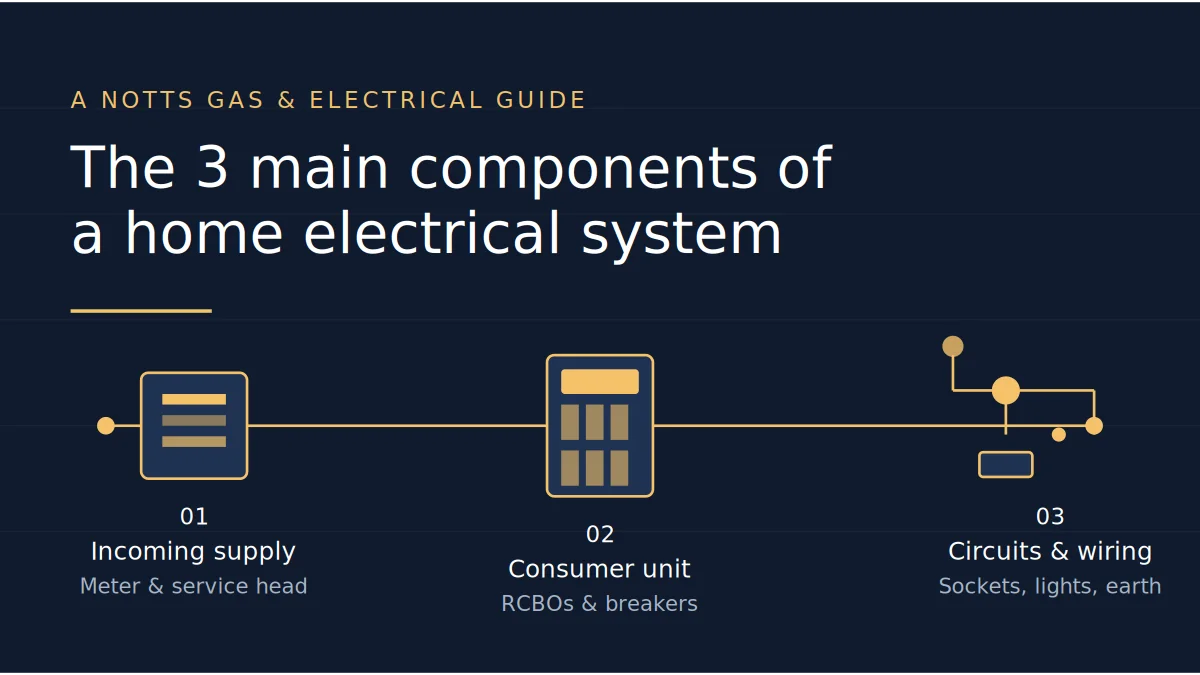
The 3 Main Components of a Home Electrical System (And When Each One Needs Attention)
You’ve called out an electrician, they’ve had a poke around, and now they’re telling you the meter tails look dodgy, and the consumer unit should really be upgraded while they’re at it. You’re nodding along, but if you’re honest, you’ve only got a vague sense of what half those words actually mean.
That’s normal. Most people only think about their electrics when something stops working. So here’s a five-minute crash course on the three main components of an electrical system in a typical UK home, what each one does, and the signs that one of them is asking for attention.
Why it helps to know the three main components of an electrical system
You don’t need to be able to wire a socket. You do need enough vocabulary to have a sensible conversation when an electrician is quoting you, especially when the quote includes a £900 consumer unit upgrade and you’re not sure whether that’s reasonable or whether you’re being sold something you don’t need.
Knowing the three main components of an electrical system, what they look like, what they do, and roughly where the boundaries sit, gives you a fighting chance of asking the right questions. It also helps you spot the early warning signs before something becomes an emergency call-out at 11pm on a Sunday.
Right, the three components.
Component 1: The incoming supply
This is everything between the cable in the street and your fuse box. It includes the service head (the sealed black or grey unit where the supply cable enters your house), the electricity meter, and the short lengths of cable known as the meter tails that run from the meter into your consumer unit.
Here’s the bit most homeowners don’t realise: you don’t actually own most of this. The service head and the cable feeding it belong to your Distribution Network Operator. The meter belongs to your energy supplier. Touching any of it, or even removing the seals, is a criminal offence. If your service head is scorched, loose, or making a humming noise, you don’t call any old electrician. You call your supplier or DNO, who’ll send someone out to deal with it.
The meter tails themselves are the customer’s responsibility, and they’re a common issue in older homes. If they’re undersized, frayed, or showing scorch marks where they enter the consumer unit, they need replacing. It’s a notifiable job under Part P and not one for the weekend.
Component 2: The consumer unit (your fuse box)
The consumer unit is the brain of your home’s electrics. It takes the single incoming supply and splits it out across all the circuits in your house, while also providing the safety devices that cut the power when something goes wrong.
Older homes still have wired fuse boxes (the ones with the porcelain holders and bits of fuse wire you used to have to twist back together when the kettle and the toaster were on at the same time). Those were replaced by MCB-based boards, and the current standard in the UK is a board fitted with RCBOs, which protect against both overload and earth leakage on every individual circuit. Since the 18th Edition wiring regs were updated, new consumer units must also be made from non-combustible material, which is why you’ll see metal-cased boards now rather than the plastic ones from the 2000s.
How to tell if your consumer unit needs upgrading
A few honest signals it’s time:
- It still has rewireable fuses (the ceramic ones with fuse wire).
- It’s plastic-cased and more than 10 to 15 years old.
- It has no RCD protection at all, or just one RCD covering the whole house (meaning one fault knocks out the lot).
- It trips often, even when nothing obvious has changed.
- You’re adding an EV charger, a heat pump, or a major extension, all of which usually need a board that can take the extra load.
An upgrade isn’t always urgent. But if you’re planning any other electrical work, doing it at the same time often makes sense.
Component 3: The circuits and wiring
This is everything downstream of the consumer unit: the cables in your walls, the sockets, the switches, the lights, and the earthing system that keeps it all safe. A standard UK home will typically have separate circuits for upstairs sockets, downstairs sockets, the cooker, the shower, upstairs lights, downstairs lights, and so on. Most socket circuits are wired as ring mains, lighting circuits as radials.
The wiring itself is what dates a house. PVC twin-and-earth (the grey or white flat cable you see in lofts) has been standard since the 1960s. If you’ve got an older property and you see rubber-sheathed, lead-sheathed, or cloth-covered cable anywhere, you’re looking at wiring that’s probably 50-plus years old and well past its serviceable life.
Common signs the wiring in your home is past its best
- Sockets or switches that feel warm to the touch.
- Flickering or dimming lights when other appliances kick in.
- Scorch marks or brown discolouration around socket faces.
- A persistent burnt-plastic smell with no obvious source.
- Circuits that trip when it rains (often a sign of water ingress on outdoor or garage wiring).
An Electrical Installation Condition Report (EICR) is the way to get a qualified assessment of your wiring’s condition. Landlords in England are legally required to have one every five years. For homeowners it’s optional, but if you’ve just bought an older house and the survey was vague about the electrics, it’s money well spent.
How the three components work together
The reason we’re walking through all three is that they depend on each other. A shiny new consumer unit on tired rubber-sheathed wiring won’t fix the underlying problem, it’ll just trip more accurately when the wiring faults. Equally, a full rewire on a property whose meter tails are undersized leaves a bottleneck right at the front door.
A decent electrician will look at all three before quoting, not just the one bit you’ve called them about.
If you’d like a sensible second opinion on any of the above, our domestic electrician team in Nottingham is happy to take a look. We’ll tell you what genuinely needs doing now, what can wait, and what’s fine to leave alone, no hard sell, just an honest assessment from a Gas Safe and NICEIC-registered team that’s been working across Nottingham for over 10 years.