Consumer Unit Upgrade Cost in 2026: A Nottingham Homeowner’s Guide
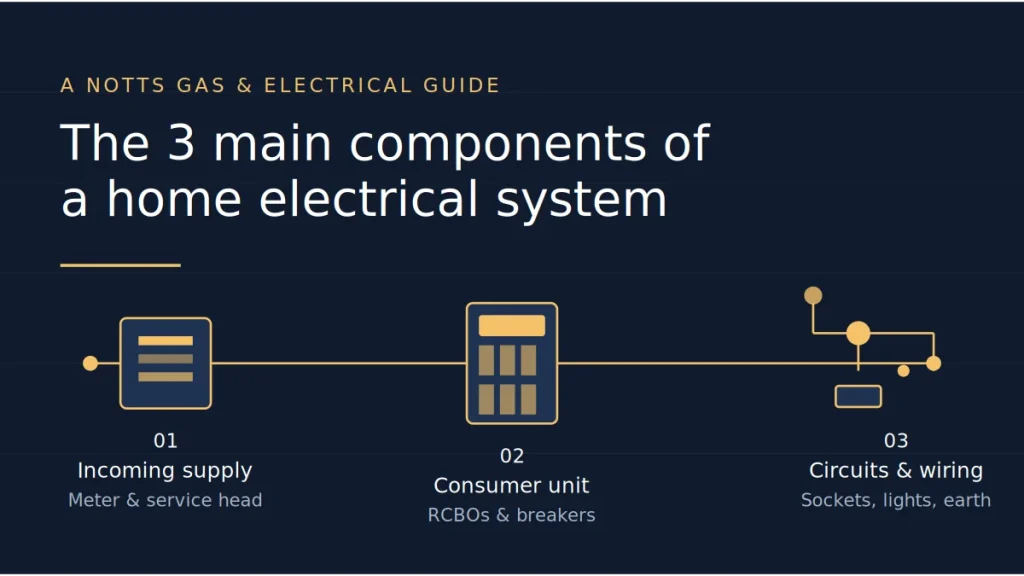
Your consumer unit is the one bit of your home’s electrics you never think about, right up until the moment it starts tripping every time the kettle and the toaster go on together, or a survey flags it during a house sale. It’s the grey (or, if it’s old enough, cream plastic) box that splits your incoming supply into the circuits around your home. And in a lot of Nottingham properties, particularly the 1960s and 70s estates, it’s well overdue for an upgrade.
How much a consumer unit upgrade costs in 2026
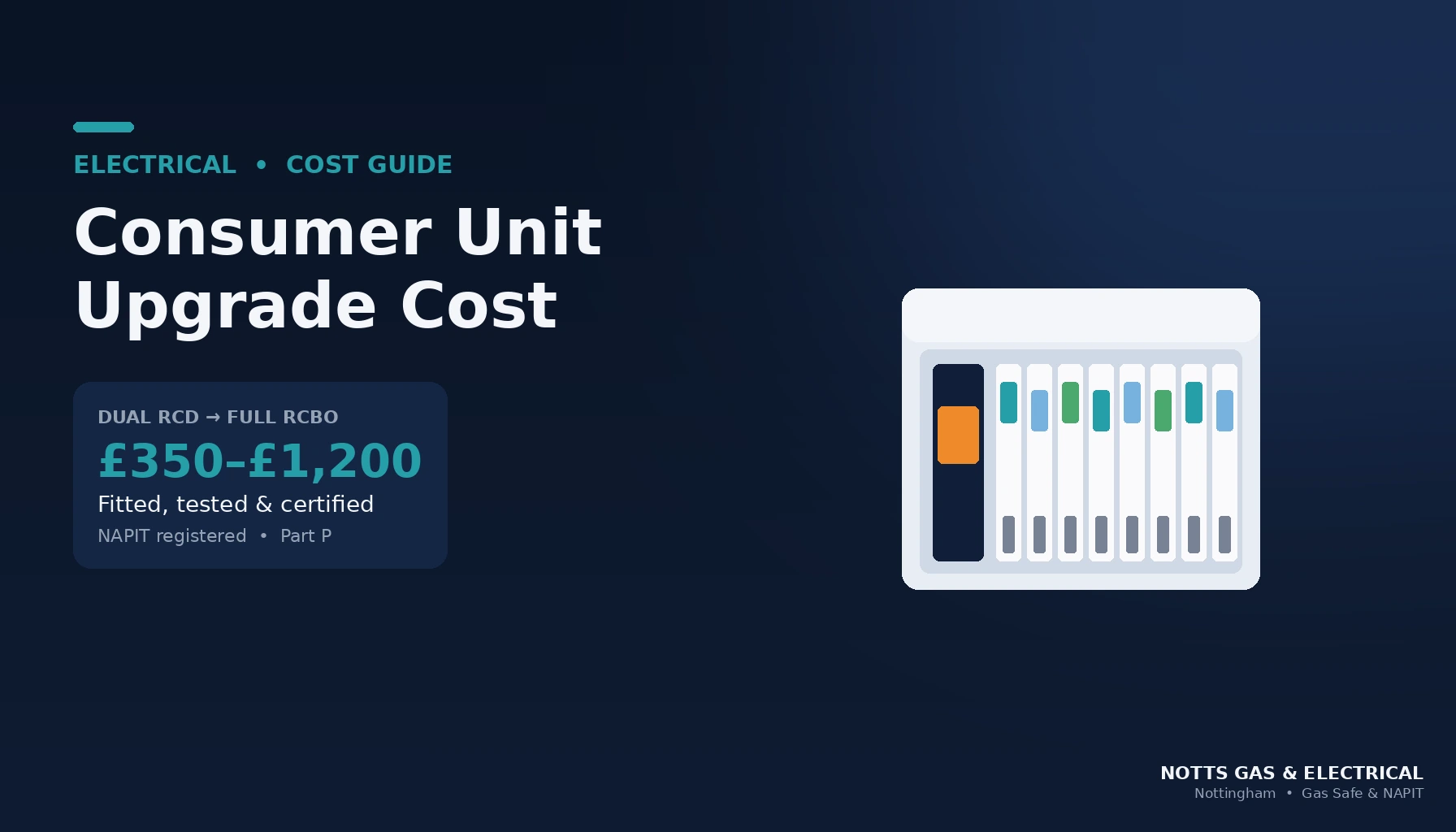
The realistic range for a consumer unit upgrade in 2026 is £350 to £1,200, depending mostly on the type of board and the number of circuits. For most homes, a standard replacement lands between £500 and £800, while a full RCBO board (more on that shortly) sits closer to £800 to £1,200.
That price should include removing the old unit, supplying and fitting the new one, testing every circuit, an Electrical Installation Certificate, and Part P notification to Building Control. If a quote looks suspiciously cheap, check what’s actually in it, because certification and testing are not optional extras.
The number of circuits is the single biggest factor. A small flat with five circuits is a quick job; a four-bed detached with fourteen takes longer, needs more breakers, and costs more. A typical Nottingham three-bed semi usually comes in around £700 to £900 for a compliant replacement, assuming the existing wiring passes its tests.
Signs you actually need a new fuse box
Not every tripping circuit means you need a new board, but some signs are worth taking seriously. If you’ve still got old rewirable fuses (the ones with actual fuse wire), no RCD protection at all, a burning smell or any heat from the unit, frequent unexplained tripping, or a failed EICR, then a replacement isn’t a luxury, it’s a safety job.
There’s also the capacity angle. If you’re planning an EV charger, a kitchen extension, or a garden office, an older board often can’t take the extra circuits, and an upgrade is the sensible first move. Electrical Safety First reports over 20,000 electrical fires a year in the UK, the majority from faulty products and installations, so this isn’t scaremongering.
Dual RCD vs RCBO, what you’re paying the extra for
This is the choice that drives the price difference, so it’s worth understanding. A dual RCD board splits your circuits into two groups, each protected by a shared RCD. It’s cheaper, but the downside is that if one circuit develops a fault, the whole group trips. A fault in your kitchen sockets could take your downstairs lighting out with it.
A full RCBO board gives every circuit its own combined breaker and RCD. A fault on one circuit trips only that circuit, leaving everything else running. It costs more, both in parts and in installation time, but the convenience and the fault isolation are genuinely worth it for most homes.
While we’re here: modern boards increasingly include a surge protection device (SPD), which guards your electronics against voltage spikes from lightning or grid switching. It adds roughly £80 to £150, and current regulations expect it in most installations. With a house full of smart devices and a home office, it’s usually money well spent.
The best consumer unit brands, and why the board is the cheap bit
The names worth knowing are Hager, Wylex, and Schneider Electric. These are the quality manufacturers most decent electricians fit as standard, not the budget no-names. A dual RCD unit from one of these costs £80 to £160 at trade; a full RCBO board with all its devices runs higher.
Here’s the thing, though: the board itself is the cheap part. The real value is in the labour, the testing, and the certification done correctly. A £100 box fitted badly is far more expensive in the long run than a properly installed one. Don’t shop on the board price alone.
Why it’s a NAPIT-registered job, not a DIY one
You cannot legally replace a consumer unit yourself. It’s notifiable work under Part P of the Building Regulations, and it has to be done by a registered electrician who can certify it against BS 7671, the UK wiring standard. Our electrical team is NAPIT registered and approved, which means our work is independently assessed against current standards, and you get the EIC and Building Control notification handled for you.
If your wiring’s also showing its age (rubber-insulated cables, repeated faults), a new board alone is only half the answer, and an EICR through our inspections and testing service is the best way to find out what’s really going on before you spend.
One more Nottingham-specific point. Because we handle gas and electrics as one team, jobs that cross both trades, a consumer unit upgrade that ties into a new boiler or an EV charger, get done in one visit, one quote, one point of contact. If your board’s looking tired, give Notts Gas & Electrical a ring on 0115 990 3308, and we’ll come and take an honest look.